← BackWalking guide →
Trip Overview

Osaka

3 Days · Solo · Balanced
citywalkplan.com
Daily Plan
Day 1
3 Spots
Tennoji Park · Tsutenkaku · Den Den Town
Day 2
3 Spots
Dotonbori · Shinsaibashi Shopping Street · Amerikamura
Day 3
3 Spots
Namba Parks · Kuromon Market · Osaka Castle
Trip Notes
The first page gives the full route overview. Each following page breaks the trip into a single-day map and spot cards so it is easy to share, print, or turn into a PDF.
Keep CityWalk Plan Free
Trip planning is free. If this itinerary helps, please consider booking through our partner links to support us.
No extra cost to you. Affiliate URLs can be added later.

Day 1

Osaka · 3 Spots
1
Tennoji Park
Tennoji Park
Park · 1.5-2 hours
The Tennōji Park (天王寺公園, Tennōji Kōen) is a park with botanical garden at 1–108, Chausuyama-cho, Tennōji-ku, Osaka, Japan.
NoteBring water and sun protection. Early morning or late afternoon usually feels the most comfortable.
Wikipedia →
2
Tsutenkaku
Tsutenkaku
Landmark · 1-1.5 hours
Tsūtenkaku (通天閣; lit. "Tower Reaching Heaven") is a tower and landmark of Osaka, Japan, and advertises the Hitachi company. It is located in the Shinsekai district of Naniwa-ku, Osaka. Its total height is 108 metres (354 ft); the main observation deck is at a height of 91 metres (299 ft). It is owned by Tsūtenkaku Kanko Co., Ltd.
NoteAim for early morning or late afternoon light. Popular viewpoints often need timed tickets in peak season.
Wikipedia →
3
Den Den Town
Den Den Town
Neighborhood · 1.5-2 hours
Nipponbashi is a shopping district of Naniwa Ward, Osaka, Japan. The area is centered along Sakaisuji Avenue, extending from the Ebisu-chō Interchange of the Hanshin Expressway in the south, to Nansan-dōri in the north. Known colloquially as "Den-Den Town," Nipponbashi is known for its many shops which specialize in furniture, tools, and "otaku" interests such as electronics, anime, manga, and collectibles. Nipponbashi is often compared to Akihabara Electric Town, its equivalent in Tokyo.
NoteThis area works best when you leave room to walk slowly, browse side streets, and stop for coffee or snacks.
Wikipedia →

Day 2

Osaka · 3 Spots
1
Dotonbori
Dotonbori
Neighborhood · 1.5-2 hours
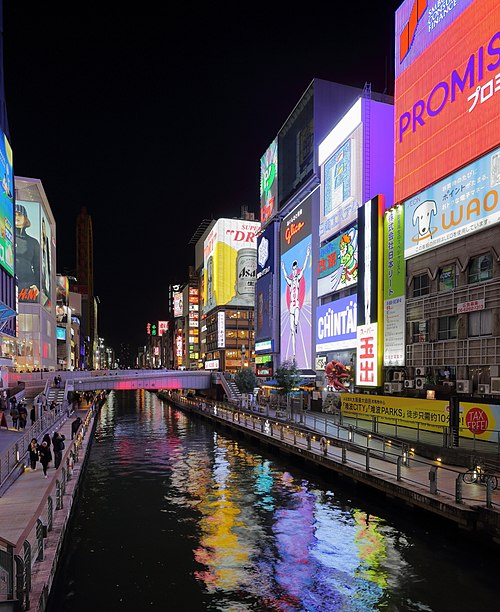
Dōtonbori or Dōtombori (道頓堀; pronounced [do̞ːtõ̞mbo̞ɾʲi]) is a district in Osaka, Japan. Known as one of Osaka's principal tourist and nightlife areas, the area runs along the Dōtonbori canal from Dōtonboribashi Bridge to Nipponbashi Bridge in the Namba district of the city's Chūō ward. Historically a theater district, it is now a popular nightlife and entertainment area characterized by its eccentric atmosphere and large illuminated signboards.
NoteThis area works best when you leave room to walk slowly, browse side streets, and stop for coffee or snacks.
Wikipedia →
2
Shinsaibashi Shopping Street
Neighborhood · 1.5-2 hours
Shinsaibashi (心斎橋) is a district in the Chūō-ku ward of Osaka, Japan and the city's main shopping area. At its center is Shinsaibashi-suji (心斎橋筋), a covered shopping street, that is north of Dōtonbori and Sōemonchō, and parallel and east of Mido-suji street. Associated with Shinsaibashi, and west of Mido-suji street, is Amerika-mura, an American-themed shopping area and center of Osaka's youth culture. Major stores and boutiques concentrates are found around the area.
NoteThis area works best when you leave room to walk slowly, browse side streets, and stop for coffee or snacks.
Wikipedia →
3
Amerikamura
Amerikamura
Neighborhood · 1.5-2 hours
Amerikamura (also America mura; アメリカ村, American Village) is a sizable retail and entertainment area near Shinsaibashi in the Chūō-ku district of Osaka, Japan. It is usually referred to by locals as "Ame-mura". Amerikamura is an area stretching from Nagahori Street to Dotonbori, located in the west side of the Shinsaibashi station. Amerikamura is identifiable by a small-scale reproduction of the Statue of Liberty that peers down on the streets.
NoteThis area works best when you leave room to walk slowly, browse side streets, and stop for coffee or snacks.
Wikipedia →

Day 3

Osaka · 3 Spots
1
Namba Parks
Namba Parks
Neighborhood · 1.5-2 hours
Namba Parks (なんばパークス, Nanba Pākusu) is an office and shopping complex located in Namba-naka Nichome, Naniwa-ku, Osaka, Japan, the south of Namba Station on Nankai Railway. It consists of a high-rise office building called Parks Tower and a 120-tenant shopping mall with rooftop garden. Namba Parks was developed by Jon Jerde of The Jerde Partnership in the footprint of the since closed Osaka Stadium. There is a carnival mall on the 1st floor. Various shops are available on 2nd to 5th floor.
NoteThis area works best when you leave room to walk slowly, browse side streets, and stop for coffee or snacks.
Wikipedia →
2
Kuromon Market
Kuromon Market
Market · 1-1.5 hours
Kuromon Market is one of the most notable market experiences in Osaka, and works well as a core stop in a first itinerary.
NoteGo earlier for the freshest food and shorter lines. Some stalls still prefer cash.
Wikipedia →
3
Osaka Castle
Osaka Castle
Historic Site · 1.5-2 hours
Osaka Castle (大坂城 or 大阪城, Ōsaka-jō) is a Japanese castle in Chūō-ku, Osaka, Japan. The castle is one of Japan's most famous landmarks and played a major role in the unification of Japan during the sixteenth century of the Azuchi–Momoyama period.
NoteCheck the official site for the latest entry policy and opening hours. Early visits are usually calmer and better for photos.
Wikipedia →
FAQ

Osaka 3-day itinerary: FAQ

How many days do you need in Osaka?
Three days is a comfortable amount of time to walk Osaka's main areas without rushing. This itinerary gives each day to one part of the city, with room for meals and unplanned detours.
Is 3 days enough for Osaka?
Yes. Three days covers the highlights of Osaka on foot at an unhurried pace. With more time you can add day trips or slower neighbourhood wandering, but three days sees the essentials.
Can you do Osaka in 2 days or one day?
Yes. For two days, follow Day 1 and Day 2 and drop the third; for a single day, walk Day 1, which covers the most iconic stretch. The route is split by area so it shortens cleanly.
How much walking is in this Osaka itinerary?
Each day is a comfortable walk grouped into one neighbourhood, so you spend the day walking rather than commuting between far-apart sights. For the most relaxed pace, follow the day-by-day plan above and let a tram or taxi cover the longest gaps.
Can you edit or export this Osaka itinerary?
Yes. It is a free, self-guided walking itinerary. Open it in the Osaka planner to reorder or remove stops, share a link, or export an offline copy to follow on your phone.