← BackWalking guide →
Trip Overview

Seoul

3 Days · Solo · Balanced
citywalkplan.com
Daily Plan
Day 1
3 Spots
N Seoul Tower · Myeongdong · Namdaemun Market
Day 2
3 Spots
Dongdaemun Design Plaza · Dongdaemun Market · Gwangjang Market
Day 3
3 Spots
Bukchon Hanok Village · Insadong · Ikseondong Hanok Village
Trip Notes
The first page gives the full route overview. Each following page breaks the trip into a single-day map and spot cards so it is easy to share, print, or turn into a PDF.
Keep CityWalk Plan Free
Trip planning is free. If this itinerary helps, please consider booking through our partner links to support us.
No extra cost to you. Affiliate URLs can be added later.

Day 1

Seoul · 3 Spots
1
N Seoul Tower
N Seoul Tower
Landmark · 1-1.5 hours
Seoul, officially Seoul Special Metropolitan City, is the capital and largest city of South Korea, and the largest city in the whole of Korea. The broader Seoul Metropolitan Area, encompassing Seoul, Gyeonggi Province and Incheon, emerged as the world's sixth largest metropolitan economy in 2022, behind New York, Tokyo, Los Angeles, Paris, and London, and hosts more than half of South Korea's population.
NoteAim for early morning or late afternoon light. Popular viewpoints often need timed tickets in peak season.
Wikipedia →
2
Myeongdong
Myeongdong
Neighborhood · 1.5-2 hours
The Cathedral Church of Our Lady of the Immaculate Conception (Latin: Ecclesia Cathedralis Nostrae Dominae Immaculatae Conceptionis; Korean: 천주교 서울대교구 주교좌 명동대성당), informally known as Myeongdong Cathedral (명동대성당), is the national cathedral of the Archdiocese of Seoul. Located in the Myeongdong neighbourhood of Jung District, Seoul, South Korea, it is the seat of the Archbishop of Seoul, Peter Chung Soon-taick.
NoteThis area works best when you leave room to walk slowly, browse side streets, and stop for coffee or snacks.
Wikipedia →
3
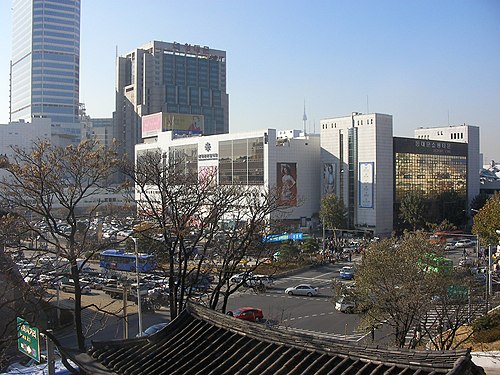
Namdaemun Market
Namdaemun Market
Market · 1-1.5 hours
Namdaemun Market (Korean: 남대문시장; Hanja: 南大門市場) is a large traditional market in Seoul, South Korea. It is located next to Namdaemun, the main southern gate to the old city. The market is among the oldest extant markets in Korea, having opened during the Joseon period in 1414. The market's character, location, and size have all changed over time. Amidst Joseon's isolationism in the 16th and 17th centuries, the market was limited to mostly Korean customers and merchants.
NoteGo earlier for the freshest food and shorter lines. Some stalls still prefer cash.
Wikipedia →

Day 2

Seoul · 3 Spots
1
Dongdaemun Design Plaza
Landmark · 1-1.5 hours
Dongdaemun Design Plaza (DDP; Korean: 동대문 디자인 플라자) is a major urban development landmark in Seoul, South Korea, designed by Zaha Hadid and Samoo, with a distinctively neofuturistic design characterized by the "powerful, curving forms of elongated structures.
NoteAim for early morning or late afternoon light. Popular viewpoints often need timed tickets in peak season.
Wikipedia →
2
Dongdaemun Market
Dongdaemun Market
Market · 1-1.5 hours
Dongdaemun Market (Korean: 동대문시장) is a large commercial district in Jongno District, Seoul, South Korea. With traditional markets and shopping centers, it is a popular shopping and tourist destination that has been designated a "Special Tourism Zone" (관광특구) since 2002.
NoteGo earlier for the freshest food and shorter lines. Some stalls still prefer cash.
Wikipedia →
3
Gwangjang Market
Gwangjang Market
Market · 1-1.5 hours
Gwangjang Market (Korean: 광장시장), previously Dongdaemun Market (동대문시장), is a traditional street market in Jongno District, Seoul, South Korea. The market is one of the oldest and largest traditional markets in South Korea, with more than 5000 shops and 20,000 employees in an area of 42,000 m2 (450,000 ft2). Approximately 65,000 people visit the market each day. The market association that manages the market is among the oldest active companies in South Korea, having been founded in 1911.
NoteGo earlier for the freshest food and shorter lines. Some stalls still prefer cash.
Wikipedia →

Day 3

Seoul · 3 Spots
1
Bukchon Hanok Village
Neighborhood · 1.5-2 hours
Bukchon Hanok Village (Korean: 북촌한옥마을) is a residential neighborhood in Jongno District, Seoul, South Korea. It has many restored traditional Korean houses, called hanok. This has made it a popular tourist destination. The area contains many hanok that date to the late 19th and early 20th centuries. During the rapid redevelopment of Seoul, efforts were made to preserve the hanok.
NoteThis area works best when you leave room to walk slowly, browse side streets, and stop for coffee or snacks.
Wikipedia →
2
Insadong
Insadong
Neighborhood · 1.5-2 hours
Insa-dong (Korean: 인사동) is a dong, or neighborhood, in Jongno District, Seoul, South Korea. Its main street is Insadong-gil, which is connected to a number of alleys that lead deeper into the district, with modern galleries and tea shops. Historically, it was the largest market for antiques and artwork in Korea. Stretching across 12.7 hectares (or 31.4 acres), the district is bordered by Gwanhun-dong to the north, Nagwon-dong to the east, and Jongno 2-ga and Jeokseon-dong to the south, and Gongpyeong-dong to the west.
NoteThis area works best when you leave room to walk slowly, browse side streets, and stop for coffee or snacks.
Wikipedia →
3
Ikseondong Hanok Village
Neighborhood · 1.5-2 hours
Ikseondong Hanok Village is one of the most notable neighborhood experiences in Seoul, and works well as a core stop in a first itinerary.
NoteThis area works best when you leave room to walk slowly, browse side streets, and stop for coffee or snacks.
Wikipedia →