Bangkok walk at a glance
| Best for | Patient walkers who'll trade heat and traffic for temples, markets, and street food |
|---|---|
| Walking time | 2–3 hours per area, best in the early morning |
| Distance | 3–5 km per route |
| Best start | Rattanakosin (the old city) at dawn, before the heat |
| Best areas | Rattanakosin, Thonburi's canals, Chinatown (Yaowarat), Silom & Sathorn |
| Use transit? | Yes — the BTS Skytrain, MRT, and river boats to skip the traffic, then walk each area |
Bangkok in 3 days: a day-by-day itinerary
Three days is the sweet spot for Bangkok on foot — one neighbourhood at a time, without rushing. Here is the day-by-day shape of a Bangkok itinerary; the free Bangkok 3-day itinerary maps every stop, and the planner can build a separate, editable plan for you.
- Day 1: Wat Arun, Wat Pho, Pak Khlong Talat.
- Day 2: Jim Thompson House, MBK Center, Yaowarat.
- Day 3: Khaosan Road, Chao Phraya Express Boat, Grand Palace.
A city that rewards curiosity
Walking Bangkok requires a different strategy than walking Paris or Tokyo. The city's scale is vast, its heat and humidity are real, and not every street is designed for pedestrians. But Bangkok rewards the walker who chooses their moments well — who moves through the early morning before the heat builds, who knows which neighborhoods to explore on foot and which to connect by BTS or river ferry, who turns off the main road and into the soi (lane) at the right moment.
The city's greatness is in its contrasts. A ten-minute walk from one of the world's most visited temple complexes leads into a working-class neighborhood of noodle shops, spirit houses at every doorstep, and schoolchildren in white-and-navy uniforms. The Chao Phraya river — the city's great artery — carries rice barges, express boats, longtail speedboats, and tourist cruises simultaneously, and the shore on both sides contains everything from golden temple spires to crumbling colonial warehouses being converted into creative districts. This is a city in constant, energetic transformation, and walking is the best way to watch it happen.
Bangkok is also, fundamentally, a city built around food. Every walk eventually becomes a food walk. The street food culture here is one of the world's finest: pad see ew fried in a wok over a powerful gas flame on a street corner, fish balls in clear broth ladled from a pot that has been simmering since dawn, mango sticky rice prepared with slow deliberation at a market stall, and the bowl of boat noodles that will change your understanding of what soup can be. The walker who eats at street level eats well.
The old city: Rattanakosin Island
Rattanakosin — the historic island bounded by the Chao Phraya and by canals dug as moats for the walled city founded as Bangkok in 1782 — is the historical and ceremonial core of the city. The concentration of royal and religious monuments here is remarkable: Wat Phra Kaew (the Temple of the Emerald Buddha) and the Grand Palace occupy an entire city block within fortified walls; Wat Pho, next door, contains the enormous reclining Buddha and has long been a center of traditional Thai massage and medicine; Sanam Luang — the royal ceremonial ground — stretches north of the palace walls, bordered by universities, government buildings, and temples.
The best approach to Rattanakosin is by river. Take the orange-flag Chao Phraya Express Boat to Tha Chang pier (N9) and walk up from the river: the transition from the working waterfront — fishermen, food vendors, the smell of river water and frangipani — to the gleaming gold of the temple roofs is abrupt and theatrical. Give the Grand Palace and Wat Phra Kaew the time they deserve; most visitors rush through in two hours what rewards four. Then walk south along the river to Tha Tian market — an old riverside market that grew up alongside the Grand Palace and became known for dried seafood — for lunch.
Cross the river from Tha Tian by the short cross-river ferry (a few baht) to reach Wat Arun, the Temple of Dawn. Its central tower, encrusted with broken Chinese porcelain tiles that glitter in sunlight, is most beautiful in the late afternoon light, seen from across the river — but climbing its steep steps partway up the tower rewards those who make the effort with a view back across the Chao Phraya toward the Grand Palace complex.
The canal walks of Thonburi
Directly across the Chao Phraya from the historic Rattanakosin district, Thonburi was actually Bangkok's predecessor — the capital for a brief period before the Chakri dynasty moved operations to the eastern bank. Today it is largely residential, and its network of khlongs (canals) preserves a way of life that has largely disappeared from the east bank. A longtail boat tour of the Thonburi canals is the classic tourist activity, but the more interesting approach is to walk along the canal banks, where wooden houses on stilts lean over the water, small wats appear around every bend, and children swim in the same canals that carry the market boats.
The canal walk near Wat Kanlaya and the lanes around Taling Chan market offer some of Bangkok's most authentic neighborhood life. Taling Chan floating market, operating on weekends, is less tourist-oriented than the famous Damnoen Saduak and worth seeking out for fresh grilled seafood and river-side atmosphere.
Chinatown at dusk
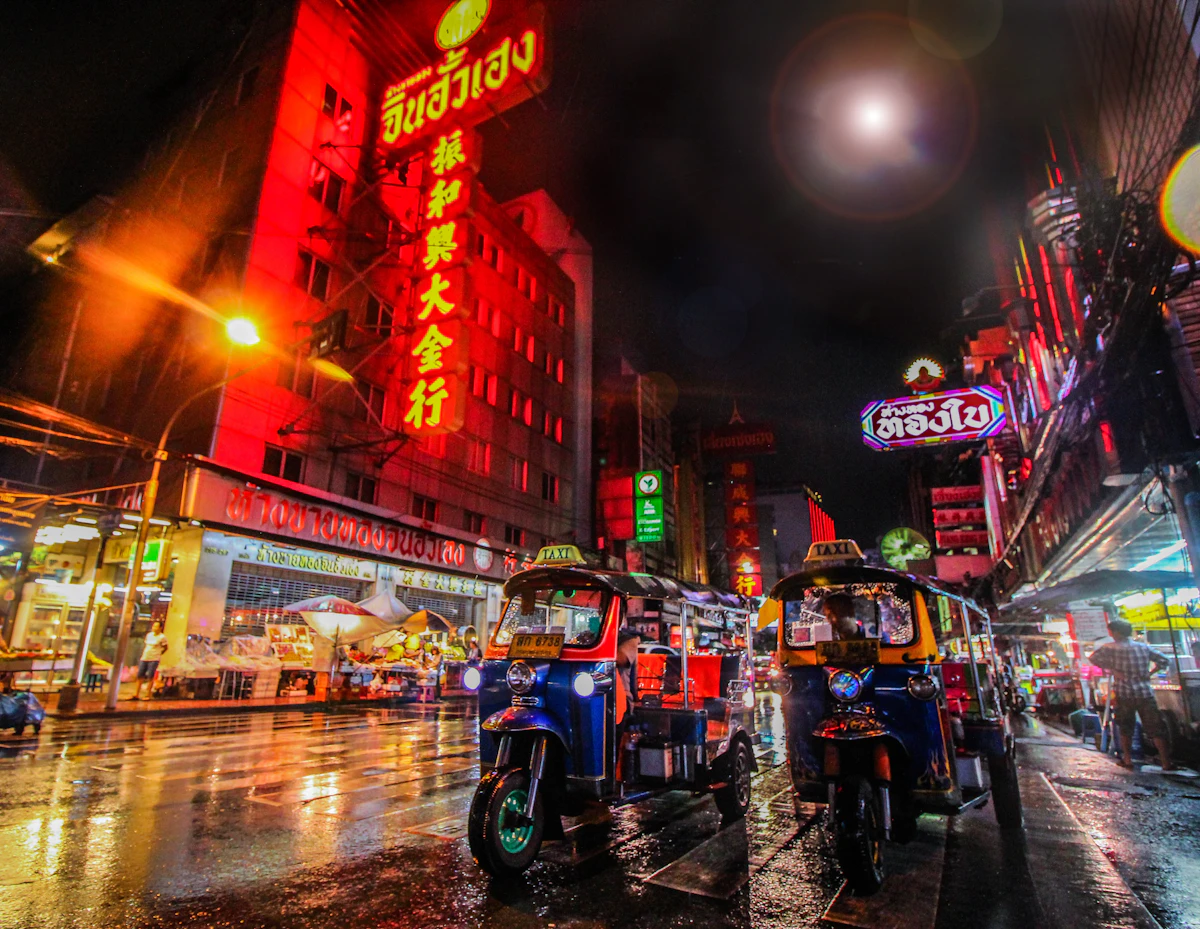
Yaowarat — Bangkok's Chinatown — is best experienced in the two hours between late afternoon and dark, when the neon signs illuminate and the street food stalls set up along both sides of the main road and its labyrinthine side streets. Bangkok's Chinatown is one of the largest and most atmospheric in Southeast Asia, established in the late 18th century when Chinese merchants were relocated to make way for the Grand Palace complex. The Yaowarat Road itself is a sensory corridor: roast duck and char siu pork hanging in shop windows, gold merchants with security guards at the door, shrines with incense burning at every intersection, and the smell of the street food that has made this neighborhood famous.
Wat Traimit, at the eastern end of Chinatown, houses the world's largest solid-gold Buddha — a five-and-a-half ton statue accidentally discovered inside a plaster exterior in 1955. The streets south of Yaowarat, toward the river, are older and quieter: Sampeng Lane is a narrow wholesale market corridor that has supplied Bangkok's traders since the 19th century. Walk it from end to end for a sense of the commercial engine that has always powered this part of the city.

Silom and Sathorn: the modern walk
Silom Road and the parallel Sathorn Boulevard are Bangkok's financial district — glass towers, international hotels, and the kind of lunch options that serve business travelers from around the world. But the area rewards walking for reasons that have nothing to do with its corporate profile. Wat Yannawa, on Charoen Krung Road in Sathon, is a temple built in the shape of a Chinese junk — an unlikely and entirely delightful monument. Patpong, the notorious nightlife street tucked between Silom and Surawong, also hosts a night market of counterfeit goods and street food that operates with complete indifference to its surroundings.
The Charoen Krung creative district — a stretch of the old road that connects Chinatown to Silom along the river — has been quietly transforming for a decade. Warehouses and shophouses converted into galleries, restaurants, and studios have made this one of Bangkok's most interesting walks: the TCDC (Thailand Creative and Design Center), housed since 2017 in the Grand Postal Building on Charoen Krung, is worth an hour, and the riverfront restaurants in this stretch serve some of the city's best food with some of its best views.
Bangkok's hidden neighborhood walks
The neighborhoods of Ari, in Phaya Thai district north of the center, and Thong Lo and Ekkamai, off Sukhumvit Road, represent a Bangkok that most short-stay visitors never find. These are the areas where the city's upper-middle class and creative community have built a neighborhood life of independent coffee shops, small restaurants, weekend markets, and streets lined with ficus trees and 1970s apartment blocks slowly being replaced by boutique condos.
Ari, around the BTS station of the same name, is the most walkable: a grid of streets where the cafés are full by 9am and the lunch spots are booked by noon. Thong Lo, off Sukhumvit, has a dense concentration of good restaurants — Japanese, Thai, Italian, and the kind of inventive modern Thai cooking that is hard to find elsewhere. On Nut, further out on the BTS Sukhumvit line, is where the local Bangkok that pre-dates the tourist economy still operates: the fresh market, the laundry services, the noodle shops that have been open in the same spot for decades. It is unglamorous and entirely worth an afternoon.
- Timing: Walk before 10am or after 5pm. Bangkok's midday heat (35°C+ in hot season) makes sustained walking unpleasant without shade.
- Transport: The BTS Skytrain and MRT subway are clean, efficient, and air-conditioned. Use them to connect neighborhoods; walk within them.
- River ferry: The Chao Phraya Express Boat is the best way to move between the old city and Silom/Sathorn. Fares on the express lines are a low flat rate per ride; check the operator's current schedule, as lines and piers change.
- Dress code: Temples expect covered shoulders and knees, and the Grand Palace turns away sleeveless tops, shorts, short skirts and see-through clothing. Lightweight linen trousers and a loose shirt work everywhere and survive the heat better than shorts.
- Street food safety: Eat where locals eat, where the wok is hot and the turnover is fast. Avoid anything that has been sitting out. Fresh fruit cut in front of you is usually a safe choice.
- Tuk-tuks: Agree on the price before you get in. They are slower than the river boat and rarely faster than the BTS, but they are fun and worth doing once.
Sources and checking notes
Visiting rules and boat access: The Grand Palace for the dress code, the orange-flag boat to Tha Chang (N9) and tuk-tuk advice; Chao Phraya Express Boat for current lines and flat fares. History and places, from Wikipedia where no official page was reachable: Rattanakosin Island, Tha Tien, Sampheng for Chinatown's 1782 origins, Golden Buddha for its weight, 1955 discovery and Guinness record, Wat Yannawa, Grand Postal Building for TCDC, Ari, Kheha BTS station for the end of the Sukhumvit line, and Taling Chan for the weekend floating market. Stop orders are editorial guidance, not measured routes. Last checked October 8, 2026.
Bangkok walking FAQ
Is Bangkok a walkable city?
Not as a whole — it's hot, huge, and built around traffic. But individual areas are very walkable, especially early: the old city of Rattanakosin, Chinatown, and the riverside. Use the Skytrain, metro, and river boats to get between them, then explore on foot.
How many days do you need in Bangkok?
Three days lets you walk Rattanakosin and the Grand Palace temples, Chinatown and the riverside, and a modern district like Silom, with time for the canals of Thonburi or a market on the edge of town.
What's the best area to walk in Bangkok?
Rattanakosin, the old royal island, holds the Grand Palace and Wat Pho within walking distance, with Wat Arun a short ferry ride across the river, and it's best at dawn before the crowds and heat. Chinatown (Yaowarat) at dusk, for the food, is the strongest next choice.
How do you deal with the heat walking Bangkok?
Walk early (before about 10am) and late, rest through the worst of the afternoon, and duck into air-conditioned malls, temples, or cafés to cool down. Carry water, wear light clothes, and use the river boats and Skytrain for any real distance.
Is it safe to walk in Bangkok?
Bangkok is generally safe for walkers; the bigger risks are traffic and scams rather than crime. Be wary of strangers who say a temple is 'closed' and offer a tuk-tuk tour, watch your footing on uneven pavements, and cross with real care.
When is the best time to visit Bangkok for walking?
November to February is the cool, dry season and by far the most comfortable. March to May is brutally hot; the June–October rainy season brings heavy afternoon downpours but quieter streets and lower prices.