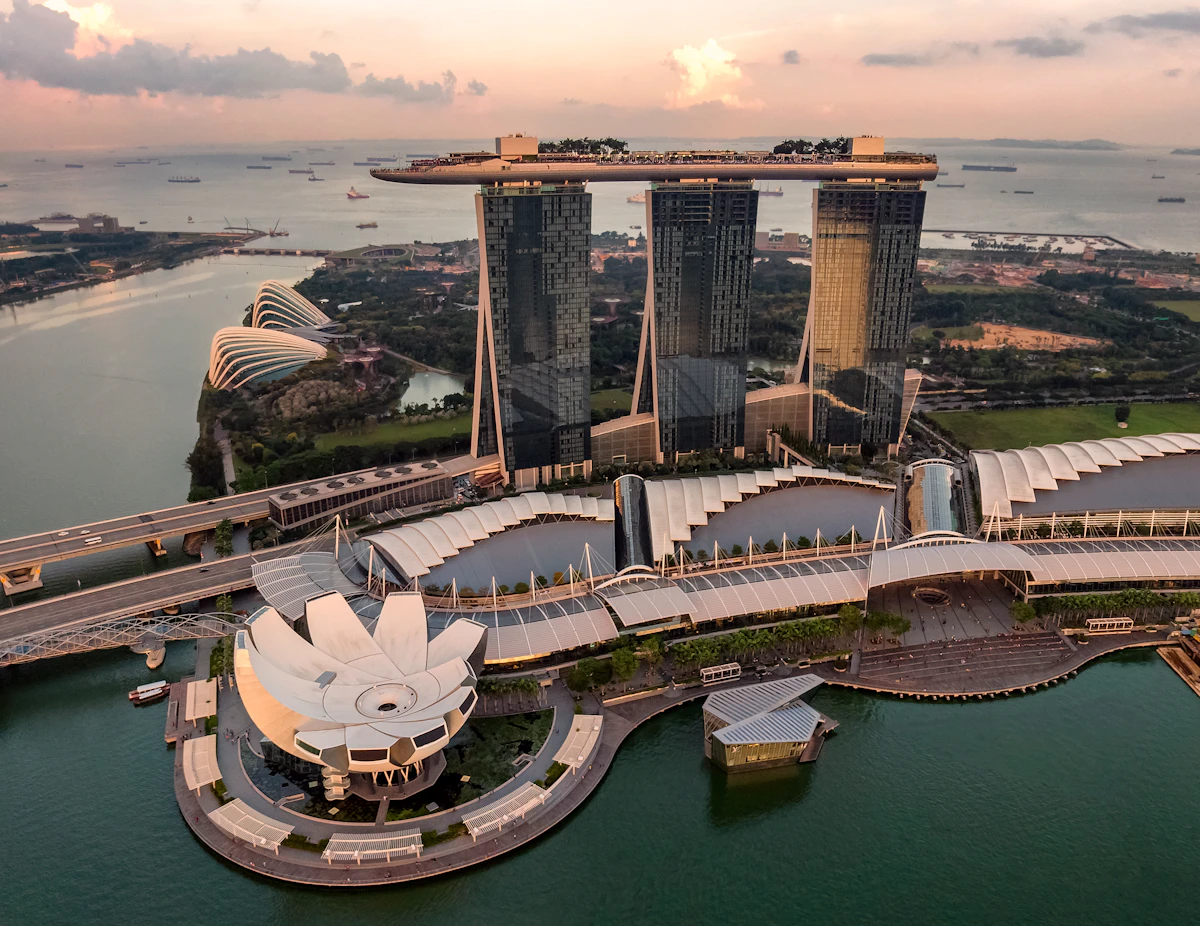
Singapore walk at a glance
| Best for | Walkers who want heat-managed comfort, gardens, food, and heritage shophouses |
|---|---|
| Walking time | 2–3 hours per area; a full day across two |
| Distance | 3–5 km per route — flat, shaded, well-paved |
| Best start | Marina Bay or the Colonial District, morning |
| Best areas | Marina Bay, Chinatown, Little India & Kampong Glam, Tiong Bahru |
| Use transit? | Yes — the cool, fast MRT between areas; each district walks easily |
Singapore in 3 days: a day-by-day itinerary
Three days is the sweet spot for Singapore on foot — one neighbourhood at a time, without rushing. Here is the day-by-day shape of a Singapore itinerary; the free Singapore 3-day itinerary maps every stop, and the planner can build a separate, editable plan for you.
- Day 1: Merlion Park, Marina Bay Sands, Singapore Flyer.
- Day 2: Orchard Road, Fort Canning Park, Clarke Quay.
- Day 3: Arab Street, Kampong Glam, Little India.
A city designed around the pedestrian
Singapore covers only about 744 square kilometers, and it has used that constraint to build one of the most carefully planned urban environments in the world. The MRT rapid transit system is excellent, but the city's greatest achievement for walkers is subtler: the network of covered walkways, the park connectors threading green corridors through the city, the heritage trails through neighborhoods that have been protected from redevelopment, and the extraordinary investment in trees that keeps the city cooler and shadier than its tropical latitude might suggest.
This is not a city that rewards the walker who arrives without knowledge of what to look for. Singapore's famous efficiency and cleanliness can, at first glance, make it seem like a city without rough edges — without the productive disorder that makes Bangkok or Istanbul so immediately engaging. But look closer, and Singapore reveals itself as a city of extraordinary layering: waves of immigration from South China, South India, the Malay archipelago, and the wider world have created neighborhoods that are each genuinely distinct in character, architecture, food culture, and social atmosphere. The walker who moves through Chinatown, Little India, Kampong Glam, and Tiong Bahru in a single day is moving through four different cities within one small island.
Singapore is also, in a category largely its own, one of the world's great food cities. The hawker centre — an open-air food hall of individual stalls, each specializing in a single dish, operating under one roof and selling to everyone at prices that make the food accessible to every income level — is Singapore's great democratic institution. Eating at a hawker centre is not a tourist experience; it is how Singaporeans eat, have always eaten, and will continue to eat. The quality is exceptional, the prices are low, and the culture surrounding the reservation of seats with a packet of tissues (a uniquely Singaporean practice called chope) is worth understanding before you sit down.
The Colonial District and waterfront
Singapore's colonial core — the area around the Padang and the Singapore River — preserves the administrative architecture of British colonial rule alongside the remarkable contemporary development of Marina Bay. Walking between the two is a study in how a city chooses to position itself between its history and its ambitions.
The Padang — the open grass field at the heart of the colonial district — is still ringed by the institutions that defined British Singapore: the Supreme Court and City Hall (now the National Gallery Singapore, which oversees the largest public collection of modern art in Singapore and Southeast Asia), the Cricket Club, the old parliament buildings. Raffles Hotel, a short walk north of the Padang, has been one of Singapore's most famous addresses since it opened in 1887 and continues to operate with a combination of genuine history and contemporary polish. The Long Bar, where the hotel says the Singapore Sling was first mixed in 1915, remains in operation.
Walk south from the Padang along the Singapore River — the original artery of the colonial trading port, now lined with restaurants, bars, and the converted godowns (warehouses) of Boat Quay and Clarke Quay. Cross the Cavenagh Bridge (completed in 1869 and the oldest surviving suspension bridge across the Singapore River, now for pedestrians only) to Empress Place, then continue along the river toward Robertson Quay, where the density of the commercial waterfront gradually relaxes into a more residential character. The Helix Bridge — a double-helix DNA-inspired pedestrian bridge connecting Marina Centre to Marina Bay Sands — is worth walking for its structure alone.
Chinatown and the shophouses
Singapore's Chinatown was established when Stamford Raffles assigned the southern bank of the Singapore River to Chinese immigrants in his 1822 urban plan. The neighborhood today is a protected conservation area of two- and three-story shophouses — the distinctive terrace buildings with covered five-foot walkways, shuttered windows, and ornate facades that blend Chinese, Malay, and European architectural influences in a style found only in Southeast Asia. The quality of shophouse preservation in Singapore's Chinatown is exceptional: the buildings have been restored without being sanitized, and the district retains genuine commercial and residential life alongside its tourist economy.
The Buddha Tooth Relic Temple on South Bridge Road — a Tang dynasty-inspired temple and museum opened in 2007 to house what is believed to be a tooth relic of the historical Buddha — is the most imposing building in the neighborhood and worth time inside: the Hundred Dragons Hall on the ground floor, the museum galleries on the upper floors, and the rooftop orchid garden around the Ten Thousand Buddhas Pagoda are all open to visitors. Maxwell Food Centre, directly adjacent, is one of Singapore's most celebrated hawker centres: Tian Tian Hainanese Chicken Rice stall has been making the definitive version of Singapore's national dish here for decades.
Little India and Kampong Glam
Little India — the neighborhood around Serangoon Road and its tributaries — is the most unmediated neighborhood in Singapore: a dense, colorful, aromatic district where the flower garland vendors, spice shops, sari emporia, and Tamil-language bookstores operate with no particular consciousness of being a tourist destination. The sensory intensity here is different from the rest of the city — turmeric and jasmine and incense, the sound of Tamil film music from open shop fronts, the vegetarian restaurants serving thalis on banana leaves at lunch to workers from the construction and service industries that define much of this neighborhood's economic life. Mustafa Centre, the 24-hour department store and supermarket, is a Singapore institution: several floors of everything you could possibly need, open all night, and deeply beloved by locals.
Kampong Glam — the Malay-Muslim quarter to the east of Little India — clusters around the Sultan Mosque, whose golden dome is visible from several streets away. The neighborhood preserves the memory of the Malay royal court of Sultan Hussein Shah, who settled at Kampong Gelam under the 1819 treaty with the British, and the streets around the mosque retain a character that is distinct from any other part of the city. Arab Street, with its textile shops selling batik and songket, transitions into Haji Lane — a narrow alley of boutique fashion, independent cafés, and street art that has become one of Singapore's most Instagram-photographed locations without losing its essential character as a working neighborhood street.

Tiong Bahru and the modern heritage walk
Tiong Bahru is one of Singapore's most written-about neighborhoods, and deservedly so. Built from the 1930s as one of the first public housing programmes of the Singapore Improvement Trust, the neighborhood's Art Deco shophouses and curved apartment blocks — designed by colonial architects who adapted Streamline Moderne aesthetics to the tropical climate — have been conserved with exceptional care. The ground floors of these buildings, originally commercial, have been occupied by some of Singapore's best independent businesses: specialty coffee roasters, bookshops, bakeries, wine bars, and restaurants that feed the creative community that has made this neighborhood its base.
The Tiong Bahru wet market, operating from early morning, is a traditional market: fresh fish, vegetables, and the cooked food hawker stalls on the upper floor that serve as the neighborhood's shared kitchen. Walking the circular loop of the conserved housing estate in the early morning — before the cafés open and while the market is at its busiest — is one of Singapore's best quiet pleasures.
Gardens by the Bay and Marina Bay
Gardens by the Bay is one of Singapore's most ambitious contemporary urban projects — 101 hectares of reclaimed land at the tip of Marina Bay, filled with two climate-controlled glass domes (the Flower Dome and the Cloud Forest), outdoor gardens, and the Supertree Grove, where 12 of the Gardens' 18 Supertrees rise up to 50 meters, covered in living plants and illuminated at night. The outdoor gardens are free to enter and are most beautiful in the evening, when the free Garden Rhapsody light show runs at 7:45pm and 8:45pm daily; the official schedule notes that times can vary for ticketed events, so check Gardens by the Bay before setting out. Walk the ticketed OCBC Skyway, 22 meters up between two Supertrees, for a broad view of the gardens and Marina Bay Sands.
The Marina Bay waterfront promenade connects Gardens by the Bay to the Helix Bridge and the Merlion Park in a continuous walkway — one of the great urban waterfront walks in Asia, particularly after dark when the Bay's buildings reflect in the water and the city's ambition to reinvent itself is most legibly on display.
- Heat: Singapore is tropical and humid year-round, with daytime highs usually around 31–33°C. Walk in the morning before 11am or after 5pm. The covered walkways connecting MRT stations to many buildings are genuinely useful for midday movement.
- MRT: The Mass Rapid Transit is clean, efficient, and air-conditioned. A SimplyGo EZ-Link card, or a contactless Mastercard, Visa, or American Express card or mobile wallet, pays fares on MRT, LRT, and buses.
- Hawker food: Eat at least one meal per day at a hawker centre. The food is excellent, the prices are low, and it is the most authentic eating experience in the city.
- Gardens by the Bay: The outdoor Supertree Grove is free. The glass domes require tickets. The free Garden Rhapsody show is scheduled for 7:45pm and 8:45pm daily; verify the official calendar for event changes.
- Heritage districts: All four major heritage districts (Chinatown, Little India, Kampong Glam, Tiong Bahru) are well-served by MRT. Each is compact enough to cover on foot in two to three hours.
- Southern Ridges: The 10km hilltop walking trail connecting Mount Faber to Kent Ridge Park, via the Henderson Waves bridge (the tallest pedestrian bridge in Singapore) — one of the city's finest walks and often skipped by short-stay visitors.
Singapore attractions worth planning around
Marina Bay and the heritage districts are easy to keep flexible. Ticketed attractions such as Gardens by the Bay, observation decks, the Night Safari, and Sentosa experiences are the stops to schedule first.
Affiliate disclosure: if you book through these links, CityWalk Plan may earn a commission at no extra cost to you. Availability and prices are set by the partner.
Sources and checking notes
Land area: SingStat; climate and rainy months: Meteorological Service Singapore; Civic District, Cavenagh Bridge, Kampong Gelam, and Tiong Bahru history: Roots (National Heritage Board); Long Bar: Raffles Singapore; temple floors and opening: Buddha Tooth Relic Temple & Museum; Supertrees, OCBC Skyway, and Garden Rhapsody: Gardens by the Bay; fare payment: SimplyGo; Southern Ridges and Henderson Waves: NParks. Stop orders are editorial guidance, not measured routes. Last checked October 8, 2026.
Singapore walking FAQ
Is Singapore a good city for walking?
Yes — one of the easiest tropical cities to walk: flat, clean, shaded, with covered walkways and frequent parks. The heat and humidity are the only real challenge, and the air-conditioned MRT covers any longer distance between districts.
How many days do you need to walk Singapore?
Two to three days: Marina Bay and the gardens, Chinatown and the Civic District, and Little India with Kampong Glam, plus a quieter walk through Tiong Bahru. It's compact, so you see a lot on foot in a short trip.
How do you deal with the heat and humidity in Singapore?
Walk in the morning and evening, use the shaded park connectors and covered five-foot ways along the shophouses, and dip into the MRT or a mall to cool off. Carry water, and treat a sudden downpour as a coffee break — they pass fast.
What's the best area to walk in Singapore?
Chinatown and the Civic District for the heritage shophouses and colonial buildings, and Little India and Kampong Glam for the most atmospheric street life. Tiong Bahru is the strongest low-key, local-feeling choice.
Is it safe to walk in Singapore?
Singapore is among the safest cities in the world to walk, day or night, with very low crime. Just mind the heat, follow the jaywalking rules (they're enforced), and watch for cyclists on the shared park connectors.
When is the best time to visit Singapore for walking?
Singapore is hot and humid year-round, just off the equator, so there's no real 'best' season — only wetter and drier. February is usually the driest month; November to January brings the heaviest rain.