The problem with over-planning
Over-planning doesn't just fill your days — it fills your head. When every hour is accounted for, you move through a city like you're executing a to-do list rather than experiencing a place. You're physically present but mentally elsewhere, checking items off rather than paying attention.
Worse, an over-packed itinerary makes you brittle. One queue, one closed museum, one meal that takes longer than expected — and the whole day starts to feel like a failure. You end up stressed in a city you traveled thousands of kilometers to enjoy.
What a loose itinerary actually looks like
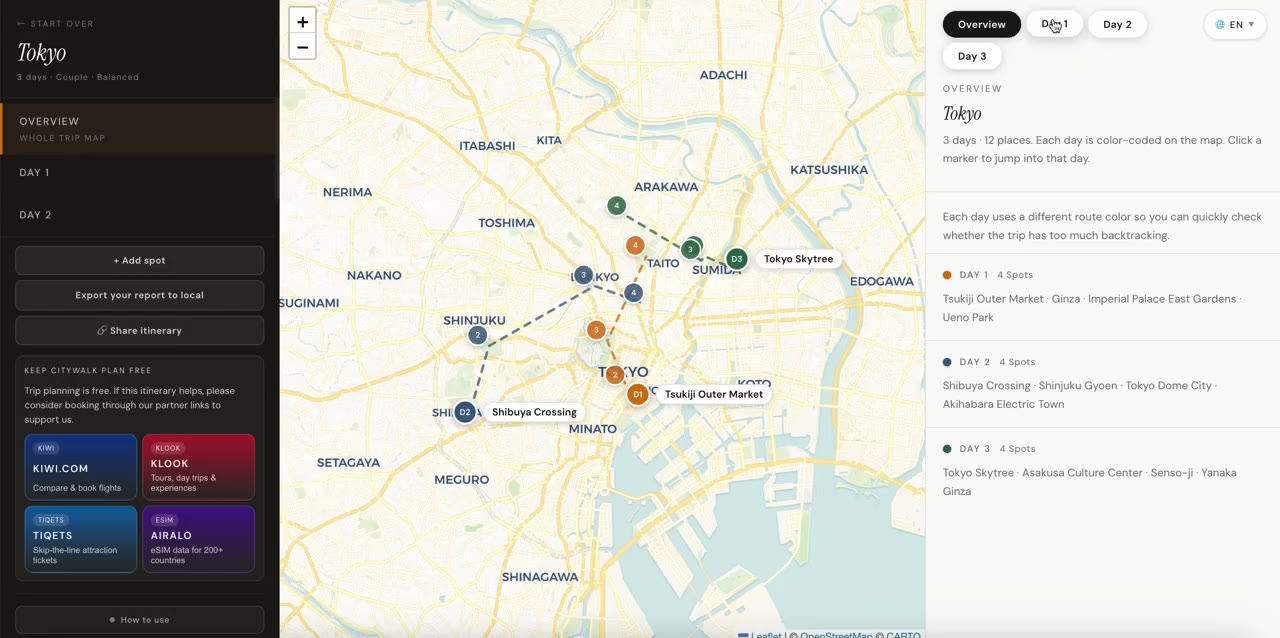
A loose itinerary is not no itinerary. It's a framework that creates shape without creating obligation. The difference between the two is what you do with empty time: a tight itinerary treats gaps as failures; a loose itinerary treats them as the point. That's how our Rome 3-day walk is laid out — anchors set, the gaps left to you.
In practice: plan your mornings (mornings are good for energy and shorter queues), leave afternoons open, and never schedule more than two or three things in a single day. If you finish early, explore. If you finish late, let something drop. Neither outcome is a problem.

The 3-anchor rule
For each day, pick three anchors — places or experiences that give the day its shape. One in the morning, one around midday, one in the evening. These can be as simple as "a market," "a museum," and "a neighborhood I haven't walked yet."
Everything else is unscheduled. What happens between the anchors is up to the day. Sometimes nothing remarkable occurs. More often than you'd expect, something does.
Protecting your spontaneity
Some of the best things in travel require time you haven't pre-allocated. A café that deserves an extra hour. A viewpoint that turns out to be perfect at this specific light. A district you walked into by accident and want to keep walking.
You can only say yes to these things if you haven't already committed that time to something else. Spontaneity isn't an accident — it's a space you deliberately protect in your schedule.
What to do when plans fall apart
A museum closes unexpectedly — a strike, a private event, a renovation that started a week early. It rains all day when the forecast promised sunshine. You're more tired than you expected, bone-tired in the way that only travel produces, where even the thought of another cobblestone square feels like too much. These aren't failures. They are, in their own way, the most honest version of what a city has to offer.
When you're performing tourism — ticking boxes, photographing landmarks, moving according to schedule — you see the city's curated face. When plans fall apart and you're forced to improvise, you see how a city actually behaves. A rainy afternoon in a covered market. A quiet hour in a church you ducked into for shelter. A long lunch that stretched because there was no reason to rush anywhere.
The practical reframes: when a museum is closed, ask what's nearby that you wouldn't have found otherwise. When it rains, accept that you're going to get wet and walk anyway — cities in the rain have a quality that cities in sunshine don't, emptier and more atmospheric. When you're too tired to walk, give the tiredness what it wants. Find a park bench or a café terrace and sit for as long as it takes. The city isn't going anywhere. The itinerary can wait.
The deeper reframe is this: a trip where everything goes according to plan teaches you very little. A trip where things go sideways teaches you how to find something good in any situation — which is, arguably, the real point of travel.
How to use a planner without becoming its prisoner
Trip planners, including this one, are tools for orientation — not contracts. Use them to understand a city's geography, identify what's close to what, and ensure you don't accidentally put your hotel on the opposite side of town from everything you want to see.
But treat the output as a starting point, not a script. Move things around on the day. Skip things that don't feel right in the moment. Add things you discover en route. The itinerary should serve the trip, not the other way around.
The goal isn't to see the maximum number of things. It's to actually be somewhere — present, curious, unhurried. That requires space. Leave some.
Build a minimum viable day
A loose plan still needs a shape. Before you leave, choose one neighborhood, one thing that is genuinely time-sensitive, and one optional finish. The neighborhood prevents cross-city zigzags. The timed item protects the reservation or opening hour that would be difficult to recover. The optional finish gives the day a direction without turning it into an obligation. Everything else can sit in a small “nearby if useful” list.
For example, a Lisbon day might have Alfama as the neighborhood, the castle at opening as the fixed anchor, and sunset at a miradouro as the possible finish. A bakery and two viewpoints can remain candidates rather than promises. If lunch lasts longer than expected, nothing has failed. If the streets are quiet and your energy is good, you already know what could come next.
Separate fixed decisions from reversible ones
Not every travel decision deserves the same amount of commitment. A sold-out museum slot, intercity train, or dinner reservation is expensive to change, so put it on the plan and build around it. The order of two nearby parks is cheap to change, so decide on the street. This distinction keeps planning effort focused where it protects the trip.
A useful pre-trip check has three columns. “Fixed” contains reservations, closures, and the last train home. “Preferred” contains the two or three experiences that would make the day satisfying. “Optional” contains everything you could skip without regret. If the fixed column is crowded, the day is not loose yet. Move a reservation, remove an attraction, or accept that this one day will be more structured than the others.
Use decision rules instead of extra stops
When uncertainty makes people anxious, they often answer it by adding more detail. A better answer is a simple rule. If it rains, choose the indoor anchor closest to the hotel. If the lunch queue is longer than twenty minutes, use the saved café nearby. If everyone is tired after the second stop, take transit back rather than completing the loop. If a street market is lively, drop the next minor sight and stay.
Rules work because they make a choice once without pretending you know tomorrow's conditions. Keep them short enough to remember. They should protect comfort, reservations, and the route home—not dictate every hour. A screenshot or exported copy of the day's anchors is enough; you do not need a minute-by-minute spreadsheet in your pocket.
How much empty time is enough?
For a normal sightseeing day, leave at least one third of the waking hours unassigned. That does not mean you will sit still for a third of the day. Walking between close stops, finding lunch, waiting for a table, looking inside an unplanned shop, and resting on a bench will use the space naturally. The empty block is where the actual city enters the itinerary.
Families, slower walkers, photographers, and anyone dealing with heat or hills may need closer to half the day unscheduled. A solo traveler who enjoys moving quickly may need less. The test is not the percentage itself: imagine your first anchor takes an hour longer than expected. If the rest of the day immediately becomes a race, remove something before you go.
Review the day without grading it
At night, ask what gave you energy, what drained it, and which neighborhood you want more of. Use those answers to edit tomorrow. Do not count completed stops. A missed landmark is information, not a score. Perhaps it was too far away, the weather changed, or another place was better than you expected. That is exactly what a loose itinerary is designed to absorb.
The practical outcome is not less planning; it is planning at the right resolution. Decide the city, neighborhood, anchors, constraints, and escape route in advance. Let weather, appetite, curiosity, and the people you are with decide the small turns. You arrive prepared without making the trip perform a script written before you had seen the street.
Sources and checking notes
Lisbon example: Visit Lisboa's Alfama page for the neighborhood, the Sé, Miradouro de Santa Luzia and the climb to the castle; the Castelo de São Jorge schedules page for its 9:00 AM daily opening and closing days; the Museu Nacional do Azulejo site, which says the museum is closed for works, so it is no longer suggested here. Stop orders are editorial guidance, not measured routes. Last checked October 8, 2026.