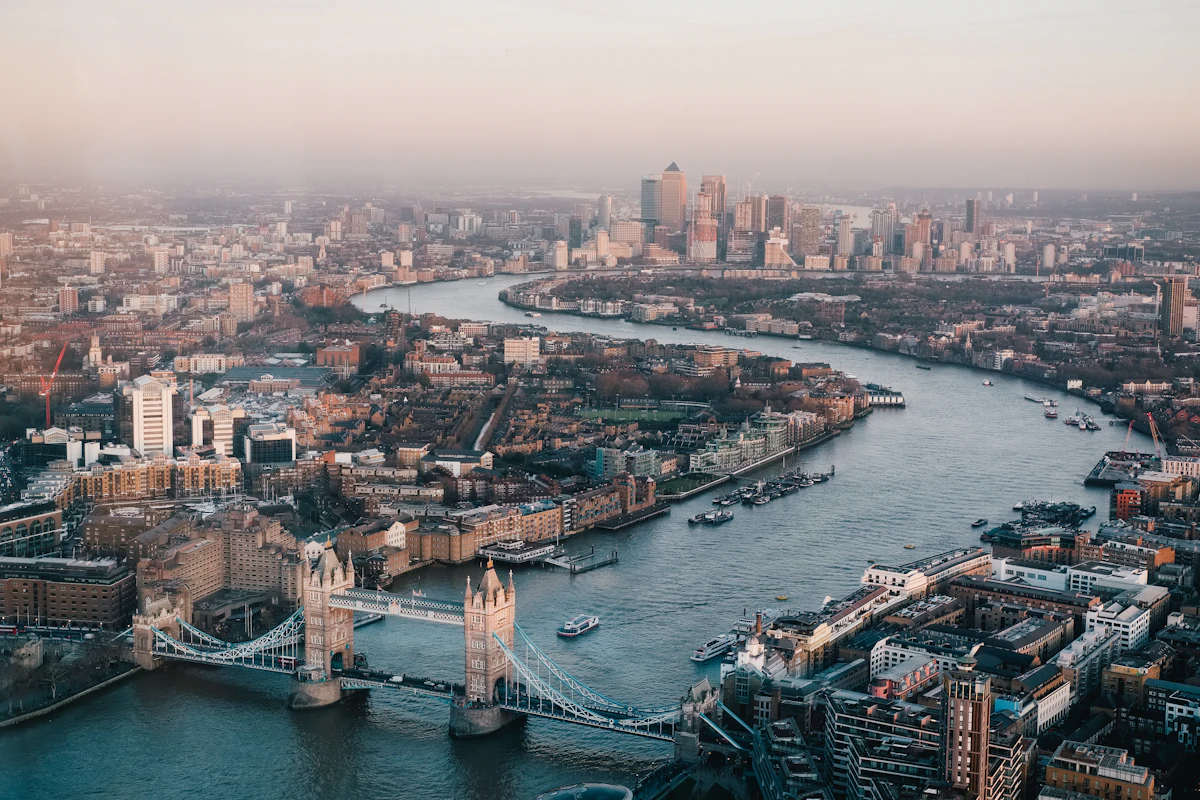
London walk at a glance
| Best for | First-timers who want the Thames, the icons, and a riverside spine |
|---|---|
| Walking time | Varies with chosen streets, river access, crowds, and attraction stops |
| Distance | Not calculated here; verify the exact streets and distance in current walking directions |
| Best start | Morning, before the South Bank crowds build |
| Best areas | The South Bank (Westminster–Tower), the City & East End, Notting Hill & the parks |
| Use transit? | Some — the Tube and walking complement each other; the centre is walkable |
London in 3 days: a day-by-day itinerary
Three days is the sweet spot for London on foot — royal Westminster and the river, the historic City and the East End, and the museums and parks of the West End, without rushing. The free London 3-day itinerary is a static example with daily stop groups and overview maps. Use it as a reference, then generate a separate editable London plan; the planner does not import this exact sample.
- Day 1 — Westminster & the river: Big Ben, Westminster Abbey, and Buckingham Palace, then the South Bank walk past the London Eye and Tate Modern to Tower Bridge.
- Day 2 — The City & East End: St Paul's Cathedral, the Tower of London, then the markets and street art of Shoreditch and Spitalfields.
- Day 3 — West End & parks: the British Museum, Covent Garden and Soho, then Hyde Park and the museums of South Kensington — the best free things to do in central London.
Choosing a base for these walks? Our guide to the best area to stay in London for walking compares Covent Garden, the South Bank, Westminster and Bloomsbury.
The Thames Path walk
If you walk only one route in London, make it a stretch of the Thames Path. The National Trail follows the river for 185 miles from its source in the Cotswolds to Woolwich, but the central London section — roughly from Putney in the west to Greenwich in the east — is among the finest urban walks anywhere in Europe. You can do it in sections across several days, or commit to a single long day and cover the heart of it.
The South Bank is the natural spine. Start at Tate Modern, housed in the converted Bankside Power Station, and walk east past the Globe Theatre and Borough Market, where food has been traded for around a thousand years. The path continues past the Golden Hinde replica and Southwark Cathedral, rounds the bend at London Bridge, and opens onto views of the Tower of London and Tower Bridge that still stop people mid-stride, no matter how many times they've seen the photographs. From Tate Modern to Tower Bridge is about 2.4 km by the riverside (Bankside, Clink Street and the Queen’s Walk) or 2.0 km by the shortest streets; OpenStreetMap foot routing puts it at 27–32 minutes of walking (we measured both on 8 October 2026).
Cross Tower Bridge on foot — it's free, though the high-level walkways and their glass floor require a ticket to the Tower Bridge Exhibition — and you're in Bermondsey, one of London's most genuinely transformed neighbourhoods of the past decade. The Bermondsey Beer Mile, White Cube gallery, and Maltby Street Market all reward the walker who continues east along the south bank rather than turning back toward the centre.
For the north bank stretch, the riverside walk from Embankment toward St Paul's and then east through the City toward the Barbican is a different register entirely: finance and history layered on top of each other in a way that only London manages. The Roman wall fragments near the old Museum of London site are easy to miss (the renamed London Museum opens at Smithfield on 28 November 2026), but they are genuinely remarkable — remnants of Londinium sitting under office buildings and car parks, periodically surfacing to remind you of the age of what you're walking through.
The City and East End
The Square Mile — the City of London — is best walked on a weekday, when it is a functioning financial district, and again on a Sunday, when it falls almost entirely silent and becomes something else: a strange, emptied stage set of glass towers and medieval churches where you can hear your own footsteps. Wren's churches, built in the aftermath of the 1666 Great Fire, are scattered across the City in improbable density — there are over twenty of them within the Square Mile. Many open on weekdays; check each church before you go.
From the City, continue east toward Brick Lane, checking current walking directions for the exact streets and distance. The street shifts in register several times across its length: the southern end meets Whitechapel High Street; the busiest stretch runs through Spitalfields and Banglatown, with vintage markets, galleries, Bangladeshi restaurants and sweet shops, and Hawksmoor’s Christ Church nearby; and the northern end crosses Bethnal Green Road toward Shoreditch’s creative quarter. The Truman Brewery — a former brewery (closed in 1989) turned arts and events space — anchors the middle of this corridor.
Shoreditch itself rewards slow walking. The murals change constantly, the coffee shops operate at a level of quality that would be notable in any city in the world, and the side streets between the main drag and the canal contain architecture in every state from Victorian warehouse to gleaming glass insertion. Columbia Road Flower Market, a few streets north, operates on Sundays and is one of London's genuine spectacles: a narrow Victorian street entirely occupied by flower sellers, crowded with buyers, and surrounded by independent shops, most of which open on Sunday.
London by neighbourhood
Three neighbourhoods reward extended walking exploration above all others, each offering a very different face of the city.
Shoreditch and Hackney are the eastern creative quarter that has replaced the working-class industrial East End over two decades of gradual transformation. The change is well-documented and contested, but the streetscape is genuinely interesting: Victorian warehouses converted into studios, railway arches occupied by small food businesses and craft workshops, canal towpaths linking parks to markets. Broadway Market on a Saturday morning is one of the best food markets in the city — independent, well-curated, with a genuinely local character that has survived its own popularity.
Bermondsey, south of the river and east of Borough, was a leather-tanning and food-processing district for centuries and is now one of the most interesting urban transformations in recent London history. Bermondsey Street — a former road to the medieval Cluniac priory — is lined with galleries, restaurants, and the Fashion and Textile Museum. The railway arches along Druid Street and Maltby Street have become a destination for independent food producers and weekend market stalls. The neighbourhood still has enough of its industrial past visible to feel honest rather than merely trendy.
Notting Hill offers the western version of this story: a neighbourhood that passed through post-war Caribbean immigration, carnival, gentrification, and global fame (aided by a 1999 film that did it few favours) to arrive at a version of itself that is simultaneously overpriced and genuinely beautiful. The painted stucco terraces on Ladbroke Grove and the streets around Portobello Road are among the most photogenic in the city. Portobello Road Market operates daily at different scales — the full antique market runs on Saturday — and the stretch from Notting Hill Gate up to the Westway underpass is one of the most varied market streets in Europe.

A suggested walking route
If you have one day and want the river London everyone pictures, this South Bank walk keeps the Thames on your left from Westminster all the way to Tower Bridge:
Westminster (Jubilee/District/Circle) → Westminster Bridge → London Eye → Southbank Centre → Tate Modern → Shakespeare’s Globe → Borough Market → Tower Bridge → London Bridge
This stop order follows the South Bank riverside spine, but closures, crossings and chosen entrances change the exact street distance and time. Check current walking directions, then start across the water from Big Ben, pass the London Eye and Southbank Centre, and continue past Tate Modern, Shakespeare’s Globe and Borough Market toward Tower Bridge. Go in the morning before the crowds, and time it so Borough Market lands at lunch. Want it mapped day by day? Our ready-to-print London sample lays the stops out in order. Crossing the Channel next? Pair this with our Paris walking guide.
Walking London in different seasons
London's weather is famously indifferent to the preferences of its visitors, but the city changes enough across the year that the timing of a walking trip is worth considering.
Spring (April to May) is London's most beautiful season for walking. The royal parks — Hyde Park, Kensington Gardens, St James's Park, Green Park — are transformed by blossom and new leaf, and the light quality in May is exceptional. The Chelsea Physic Garden is in bloom, and many private garden squares open to the public for one weekend each June during London Open Gardens. The tourist crowds are building but haven't yet reached summer density, and the days are long enough to walk until 8pm.
Autumn (October to November) brings the best skies and the most dramatic light. The plane trees that line many of central London's streets turn gold and copper, and the parks are spectacular in the brief window between leaf-turn and leaf-fall. This is also the best season for gallery-going between walks — the major institutions launch their most significant exhibitions in autumn, and the crowds are slightly thinner than in summer.
Summer (June to August) brings long days — London doesn't get fully dark until nearly 10pm in June — and the full operation of the outdoor food markets, street festivals, and pop-up events that make the city feel most alive. The parks fill with picnickers and the canal towpaths are busy. Heat is rarely extreme, though the Underground becomes genuinely unpleasant. Walking is the sensible alternative.
Winter has its advocates. The Christmas lights on Oxford Street and Carnaby Street are actually rather beautiful, the museums are warm and somewhat less crowded than in summer, and a walk through the City on a cold clear morning — with frost on the churchyard flagstones and few other people about — is one of those experiences that belongs specifically to London in December.
What to wear and carry
London's pavements are unforgiving on anything other than proper walking shoes. The city's surfaces vary wildly — cobblestones in the City and markets, worn flagstones in parks, uneven Victorian kerbs in residential areas — and a day of serious walking will cover 15,000 to 20,000 steps without effort. Comfortable, well-broken-in footwear is non-negotiable.
- Layers: London weather changes within a single day. A packable waterproof jacket and a light mid-layer cover most scenarios year-round.
- An Oyster card or contactless payment: The London transport network is integrated and efficient. Load a card at any station or simply tap in with a bank card — daily capping means you won't pay more than the cap on most TfL journeys, as long as you touch in and out with the same card.
- Cash: Less essential than in many cities — London is predominantly cashless — but useful for small market stalls, some independent cafés, and the occasional cash-only pub.
- A bag with room to expand: Market days in any London neighbourhood will test your restraint. Leave space.
- The Citymapper app: More reliable than Google Maps for London's complex bus network and real-time tube disruptions. Free, and indispensable.
- Water: London tap water is perfectly drinkable and many cafés will refill a bottle for free. Since 2019 the Mayor and Thames Water have been adding public water fountains across the city.
London rewards the walker who comes without a fixed agenda. The city is too large, too layered, and too contradictory to be resolved in any set number of days — but that is precisely its character. Give it time on foot, resist the temptation to see only the landmarks, and the neighbourhoods will do the rest.
Sources and checking notes
Opening rules and prices change, so check: Tower Bridge entry (crossing on foot is free; the walkways need a ticket), Changing the Guard calendar, National Gallery and Tate Modern visiting pages, Portobello Road Market days, and TfL station information. The Tate Modern to Tower Bridge figures are our own measurement with OpenStreetMap foot routing (routing.openstreetmap.de); other stop orders are editorial guidance, not measured routes. Last checked October 8, 2026.
London walking FAQ
Is this a self-guided walking tour of London?
Yes. The London sample is a static self-guided reference you can view or print. To customize, share or export, generate a separate editable London plan; the planner does not import this exact sample.
What should you see in London on foot?
Walk London in three clusters: the royal core from Buckingham Palace to Westminster and the river; the City and South Bank from the Tower of London to Borough Market; and the West End and Bloomsbury around Covent Garden and the British Museum. Each is a tight, flat walk.
What can you do in one day in London?
For one day, walk Westminster and the South Bank in the morning, cross to the City and the Tower of London in the afternoon, and finish in Covent Garden. The river ties the route together.
What free things can you do in London?
London is one of the best cities for free walking: the British Museum, Tate Modern and the National Gallery are all free to enter, and the parks, the South Bank, and the changing of the guard (check the Household Division calendar) cost nothing.
Is there a ready London walking itinerary?
Yes. The free London 3-day walking itinerary is a static example with a map for each day. Use it as a reference; the planner generates a separate editable London plan.
Is London a good city for walking?
Yes, though London is large and spread out — the trick is to walk the dense central districts (the South Bank, the City, the West End) on foot and use the Tube to jump between them.
How many days do you need to walk London?
Three to four days covers the South Bank river walk, the City and East End, and an outer neighborhood or two such as Notting Hill or Hampstead, at a comfortable pace.
What is the best area to walk in London?
For first-timers, the South Bank from Westminster to Tower Bridge for the icons, and the City and East End for history and markets. Notting Hill and Hampstead are strong next choices.
Can you walk along the Thames in London?
Yes. The Thames Path and South Bank provide a long riverside walking corridor, but closures, crossings and chosen access points change the exact route, distance and time. Check current walking directions and Thames Path notices.
Is it safe to walk in London?
Central London is generally safe to walk by day and evening; use normal big-city awareness late at night and keep an eye on belongings in crowded areas and on transport.
When is the best time of year to walk London?
Late spring through early autumn (May–September) gives the longest daylight and the best chance of dry weather; bring a layer and a compact umbrella in any season.