
Paris walk at a glance
| Best for | First-timers who want to feel the city by arrondissement, not tick off monuments |
|---|---|
| Walking time | Varies with chosen streets, café breaks, crowds, and museum stops |
| Distance | Not calculated here; verify the exact streets and distance in current walking directions |
| Best start | Mid-morning, once the cafés open and before lunch service |
| Best areas | Left Bank (5th–6th), Le Marais (3rd–4th), Montmartre (18th) |
| Use transit? | Rarely — most days walk end to end; Métro or Vélib’ only for long hops |
Paris in 3 days: a day-by-day itinerary
Three days is the sweet spot for Paris on foot — the islands and the Louvre, the Left Bank, and Le Marais up to Montmartre, without rushing. The free Paris 3-day itinerary is a static example with daily stop groups and overview maps. Use it as a reference, then generate a separate editable Paris plan; the planner does not import this exact sample.
- Day 1 — The islands & the Louvre: Notre-Dame and Île de la Cité, the Louvre and the Tuileries, then along the Seine to the Eiffel Tower at golden hour.
- Day 2 — The Left Bank: the Latin Quarter and the Panthéon, the Luxembourg Gardens, Saint-Germain-des-Prés, and the Musée d'Orsay.
- Day 3 — Le Marais & Montmartre: the Marais and Place des Vosges, then up to Montmartre for Sacré-Cœur and the best free view in the city.
Choosing a base for these walks? Our guide to the best area to stay in Paris for walking compares the Marais, the Latin Quarter, the 1st and 9th arrondissements and Montmartre.
Think neighborhoods, not landmarks
First-time visitors to Paris often spend their days shuttling between the Eiffel Tower, the Louvre, and Notre-Dame — checking monuments off a list without ever feeling the city. The better approach is to anchor each day in a single arrondissement and simply walk it.
Paris has 20 arrondissements arranged in a clockwise spiral from the center. Each has a distinct personality shaped by its history, its residents, and its relationship to the river. You don't need to see all 20. You need to know four or five well. And the best way to know a Paris neighborhood is to enter it without a plan, get slightly turned around, and end up somewhere you didn't expect. That's not getting lost — that's Paris working as designed.
Paris supports many neighborhood-scale walks, but the exact street distance and time between districts depend on your start, finish and chosen streets. Check current walking directions before deciding whether to continue on foot, and keep the Métro as backup for the longer gaps.
The Left Bank loop (5th & 6th)
The 5th and 6th arrondissements — the Latin Quarter and Saint-Germain-des-Prés — form the intellectual heart of Paris. These are the neighborhoods of Hemingway, Sartre, and Simone de Beauvoir, and while the cafés have become considerably more expensive since the days of Les Deux Magots, the streets remain essentially unchanged. The same cobblestones, the same building heights, the same relationship between courtyard and boulevard that made this quarter what it was in the 1920s.
Start at Place de la Contrescarpe in the 5th, walk down Rue Mouffetard — one of the oldest streets in Paris and one of the best food markets in the city — and take your time at the stalls. The olive merchants, the fromagers, the roasting chickens on spits at the edge of the pavement: this is a street that remains genuinely lived-in rather than touristified. Cross into the 6th and work your way through Boulevard Saint-Germain to Luxembourg Gardens. The gardens are at their best in the morning, when the light is low and the metal chairs are still available. Let the loop expand around market and lunch stops, and verify its exact streets and timing in current walking directions.
Le Marais (3rd & 4th)
The Marais is the neighborhood that survived Baron Haussmann's transformation of Paris in the mid-19th century, which is why it still has medieval street patterns, Renaissance mansions, and Jewish bakeries that have been in operation for over a century. When Haussmann cut his grand boulevards through the rest of the city, the Marais was largely left alone — and the result is a neighborhood that feels like it was preserved in aspic while the rest of Paris modernized around it.
The 4th arrondissement alone could occupy two full days. Place des Vosges — Paris's oldest planned square, built from 1605 to 1612 — is the anchor. Walk outward from there in any direction: you'll find Jewish deli counters on Rue des Rosiers, contemporary art galleries on Rue de Bretagne, and the city's finest falafel on Rue des Écouffes. The Centre Pompidou sits on the Marais's western edge, but it is closed for renovation until 2030, so plan the Marais without it.
On Sunday mornings, the Marais comes alive in a particular way. On Rue de Bretagne, the covered Marché des Enfants Rouges is open on Sundays too, and the streets of the gay quarter — Rue Sainte-Croix de la Bretonnerie and its neighbors — see a mix of residents and visitors that feels genuinely relaxed rather than performed. Arrive before noon, when the best pastries are still available and the crowd hasn't yet thickened.
Montmartre (18th)
Montmartre is unavoidable and worth it — if you go at the right time. The tourists arrive after 10am; arrive before 8 and you'll have the steep streets and staircases almost entirely to yourself. The view from in front of Sacré-Coeur at dawn, with the city spread below in the morning haze, is one of the best urban panoramas in Europe. The white dome of the Basilica catches the early light in a way that doesn't photograph well but stays in memory long after the trip.
After the Basilica, head into the residential streets behind it — Rue Lepic, where Amélie's café, the Deux Moulins, still operates, Place du Tertre before the portrait artists arrive and set up their easels, and the small vineyard on Rue des Saules that produces an actual, drinkable Montmartre wine each October. This is what the neighborhood actually looks like when it's not performing for visitors: a quiet village perched on a hill, with boulangeries and retired men at café tables and cats watching from windowsills.
Montmartre's staircases are part of the walk. The Rue Foyatier steps and the funicular both reach the summit; the steps are better. The descent, back through the winding streets toward Pigalle and the broad boulevards of the 9th, takes you through some of the least-visited and most interesting transition zones in the city — the point where the village of Montmartre becomes the rest of Paris.
Canal Saint-Martin (10th)
The 10th is the most contemporary of Paris's walking neighborhoods. Canal Saint-Martin — made internationally famous by the film Amélie, though it had been a beloved local secret for decades before that — runs through its center, lined with iron footbridges, plane trees that make the water glow green in summer, and a mix of century-old cafés and the kind of new restaurants that have one-word names, natural wine lists, and menus that change daily based on what arrived at the Rungis wholesale market that morning.
The canal, ordered by Napoleon in 1802 and built between 1822 and 1825, was dug to supply fresh water to Paris and allow commercial barges to bypass the Seine. Today it's a recreational corridor with a character unlike anywhere else in the city — half working waterway, with actual boat traffic navigating the locks, and half neighborhood park where people sit on the stone banks and read in the afternoon. The nine locks themselves are worth watching as boats rise and fall through them.
On Sundays, the canal-side roads are closed to traffic and opened to pedestrians and cyclists (10am–8pm April to September, 10am–6pm October to March). It's the best day to walk the full length, from Place de la République north to the Bassin de la Villette — the large rectangular basin where you can rent boats by the hour or simply sit on the wide quays and watch the city move at its weekend pace.
Belleville & the 20th
Most itineraries for Paris stop at the Canal. The more curious walker continues east into Belleville and the 20th arrondissement — the working-class neighborhoods that remain, despite rising rents, the most genuinely diverse and culturally layered part of the city.
Belleville has been a neighborhood of successive waves of immigration for over a century: Jewish arrivals in the 1930s, then North African communities from the 1960s, Chinese from the 1980s, and more recently West African. The result is a food landscape unlike anywhere else in Paris. Rue de Belleville and its side streets offer Chinese noodle shops next to Tunisian pastry counters next to West African grocery importers next to small wine bars run by natural wine devotees from Lyon. It's the Paris that doesn't appear on the postcards, and it's indispensable.
The street art in Belleville and the neighboring Oberkampf corridor is among the most serious in Europe — not graffiti in the casual sense, but large-scale murals commissioned or semi-sanctioned, covering entire building facades with work of genuine ambition. Walk Rue Dénoyez, a short alley that has become an unofficial outdoor gallery, entirely covered in rotating works. Parc de Belleville, at the top of the hill, gives you one of the best views over Paris that most tourists never find: the Eiffel Tower in the distance to the west, the city spreading in all directions below, and almost no one else looking at it.
Père Lachaise cemetery lies beyond the park; check current walking directions for the exact approach. It is one of the great walking destinations in any city. Its winding paths between the mausoleums of artists, musicians, politicians, and writers function more like a forested village than a cemetery. Jim Morrison's grave is there, perpetually garlanded, but so is Édith Piaf's, Proust's, Chopin's, and Oscar Wilde's — the latter now behind a glass screen after years of visitors' lipstick kisses.
A suggested walking route
If you have one day and want the postcard Paris — the river, the palaces, and the grand axis — this Right Bank spine threads the icons into a single Seine-side walk:
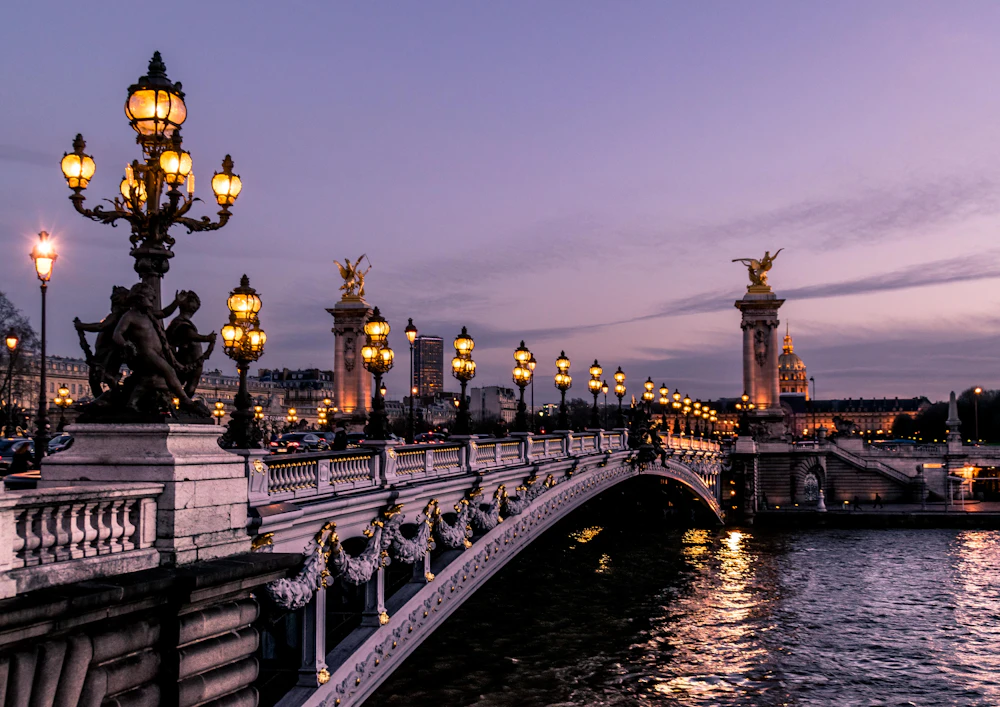
Saint-Michel–Notre-Dame → Île de la Cité & Notre-Dame → Pont Neuf → Pont des Arts → Louvre & Tuileries → Place de la Concorde → Champs-Élysées → Arc de Triomphe (Charles de Gaulle–Étoile)
This stop order follows the Seine and grand-axis landmarks, but it is not a calculated street route. Check current walking directions for the exact distance and time, then begin on the Île de la Cité, cross the Pont Neuf to the Left Bank, then the Pont des Arts to the Louvre, and continue through the Tuileries toward Étoile. For a quieter, more lived-in day, swap in the Left Bank loop above — Rue Mouffetard to the Luxembourg Gardens — or spend it entirely in the Marais. Want it mapped day by day? Our ready-to-print Paris sample lays the neighborhoods out in order. Comparing European capitals on foot? Pair this with our London, Rome, and Barcelona walks.
A 5-day walking framework
Paris rewards those who plan loosely but structure their geography. Here is one reliable framework for five days on foot — adapt it freely based on your pace and interests.
Day 1 — Orientation and the Left Bank. Arrive and shake off travel fog with a morning walk along the Seine from Notre-Dame to the Musée d'Orsay. Afternoon in the 5th and 6th: Rue Mouffetard, then the Luxembourg Gardens, a long dinner somewhere on Boulevard Saint-Germain. Keep this day light. The city takes a few hours to settle into.
Day 2 — The Marais. Full day in the 3rd and 4th arrondissements. Morning in the Jewish quarter and Place des Vosges; afternoon browsing galleries and the covered passages of the nearby 2nd arrondissement. Dinner in the Marais itself — the options in the 4th on a Tuesday evening are better than almost anywhere in the city.
Day 3 — Montmartre and Pigalle. Early start at the summit, back down through the village streets by 10am before the crowds arrive. Spend the rest of the morning in Pigalle and the 9th arrondissement — the "SoPi" (South Pigalle) area around Rue des Martyrs is one of the best food streets in Paris. Afternoon rest; evening in the 11th around Oberkampf.
Day 4 — Canal Saint-Martin and the 10th. Take this slowly. Start at République and follow the canal north, stopping wherever feels right; check current walking directions for the exact path and timing. Lunch near the Bassin de la Villette. Afternoon in the Buttes-Chaumont park — one of Paris's most underrated outdoor spaces, with a lake, a temple on a rocky island, and long grassy slopes for lying on (the central island and temple are closed for renovation). Evening back in the 10th.
Day 5 — Belleville, Père Lachaise, and wherever the morning takes you. Save this day for wandering. Belleville in the morning, Père Lachaise mid-morning, Parc de Belleville for lunch with a view. Afternoon free to revisit anywhere from the previous days that deserves a second look. Paris is a city that rewards returning to the same spot at different times of day — the light changes everything.
Paris tickets worth booking before the walk
Build the route around the timed entries, then leave the riverbanks and neighborhoods flexible. The Louvre, Musée d’Orsay, Sainte-Chapelle, Eiffel Tower, and major exhibitions are the stops most likely to sell out.
Affiliate disclosure: if you book through these links, CityWalk Plan may earn a commission at no extra cost to you. Availability and prices are set by the partner.
Tips for walking Paris
- Wear soft soles: Parisian cobblestones are beautiful and brutal. Cushioned soles are not optional after day two.
- Avoid the main streets: Rue de Rivoli and the Champs-Élysées are for orientation, not discovery. The real Paris is always one block back.
- Eat lunch early: French restaurants fill up sharply between 12:30 and 2pm. Arrive at noon and you'll have your pick of tables and the full attention of the kitchen.
- Cross the river regularly: Paris's two banks have completely different characters. Build walks that cross the Seine at least once per day — the bridges themselves are worth the detour.
- Museum strategy: If you're planning to visit a major museum, book timed entry in advance and go first thing. Treat the afternoon as walking time, not museum time.
- The Vélib' option: Paris's public bike-share system can connect neighborhoods you do not want to join on foot. Check the current service area, station availability and account requirements before relying on it.
Sources and checking notes
Check before you go: Louvre hours and admission, Sainte-Chapelle practical information, Eiffel Tower ticket tips, Palais-Royal (free entry), Centre Pompidou renovation and Paris Respire car-free Sundays. History: Wikipedia articles on Place des Vosges, the Canal Saint-Martin and Belleville. Stop orders are editorial guidance, not measured routes. Last checked October 8, 2026.
Paris walking FAQ
Is this a self-guided walking tour of Paris?
Yes. The Paris sample is a static self-guided reference you can view or print. To customize, share or export, generate a separate editable Paris plan; the planner does not import this exact sample.
What should you see in Paris on foot?
Cluster the icons by riverbank: the Ile de la Cite with Notre-Dame and Sainte-Chapelle, the Left Bank around Saint-Germain and the Latin Quarter, the 7th with the Eiffel Tower and the Orsay, and the Right Bank with the Louvre and the Marais. Each is one walkable quarter.
What can you do in one day in Paris?
For one day, walk the Ile de la Cite and the Latin Quarter in the morning, cross to the Louvre and the Tuileries, and end at the Eiffel Tower for the evening. The Seine links it all and keeps you oriented.
What free things can you do in Paris?
Much of Paris is free to walk: the banks of the Seine, the Marais, Montmartre, the courtyards of the Louvre and Palais Royal, and the parks. Several national museums are also free on the first Sunday of the month, often with free booking required (the Louvre is not one of them).
Is there a ready Paris walking itinerary?
Yes. The free Paris 3-day walking itinerary is a static example with a map for each day. Use it as a reference; the planner generates a separate editable Paris plan.
Is Paris a good city for walking?
Yes — it is one of the world’s great walking cities. It is compact, mostly flat, and dense with detail, and many days you can cross it entirely on foot; the Métro is there for the long hops between distant arrondissements.
How many days do you need to walk Paris?
Three to five days lets you walk four or five arrondissements well — the Left Bank, the Marais, Montmartre, and the Canal Saint-Martin — at a relaxed, café-paced rhythm rather than a monument checklist.
What is the best arrondissement to walk in Paris?
For first-timers, the Marais (3rd–4th) for preserved medieval streets and the 5th–6th — the Latin Quarter and Saint-Germain — for café Paris. Montmartre and the Canal Saint-Martin are strong next choices.
Can you walk from the Louvre to the Eiffel Tower?
Yes. The Seine provides a useful sightseeing spine between them, but the exact streets, distance and time depend on your chosen riverbank and stops. Check current walking directions before you go.
Is it safe to walk in Paris?
Central Paris is generally safe to walk by day and evening; the main thing to watch is pickpocketing around crowded landmarks and on the Métro, so keep bags zipped in dense crowds.
When is the best time of year to walk Paris?
Late spring (May–June) and early autumn (September–October) bring the mildest weather and long, soft light; midsummer is warm and busy, and many Parisian businesses close in August.